



“Work that is at it’s most basic, a beautiful corpse.
Technically flawless but completely without pulse.”
There has never been a better time to make something mediocre.
The tools are extraordinary and getting better every month or two. Anyone can now produce a research report that reads like it took a fortnight, a brand identity that looks like it cost six figures, a strategy deck with the confident sheen of a top-tier consultancy. Ten minutes. No craft required. And it all comes out fine.
Fine is the problem.
We were sold on the notion that once the machines learned to write and design and reason, quality would go up. Instead, volume went up, and arguably, the median point for quality went down. Hard drives, cloud servers, and LinkedIn feeds filling with work that is at it’s most basic, a beautiful corpse. Technically flawless but completely without pulse.
We gave it a name, because catchy names help, and “slop” was born. A simple and evocative moniker for content void of any soul, and the slopocalypse was next.
I don’t think the machines are the issue. How can they be? The machines are truly magnificent. Like permanently caffeinated sous chefs intent on pleasing no matter how difficult or obscure the request. But, most of us built our careers on execution, on being the person who could make the thing, and the time, cost, and skill of making the thing became commodity.
So what exactly is the purpose of you now?
In the restaurant of life, have you been reduced to simply yelling whims and commands at your infinite robot-army of world-class sous chefs?
Of course not. It would both grow tiresome, and also produce a schizophrenic menu that looks like it caters to everyone but in fact draws in nobody.
Allow me to torture you and this analogy further.
Imagine your sous chefs and line cooks beyond counting. Each one can execute any technique flawlessly, instantly, at minimal cost, without break and with an enthusiastic “yes chef”. Ask for a perfect hollandaise and it appears. Ask for a thousand and they appear too. Identical, uniform, unsweating, every single time.
If you ask them to perfectly sear a salmon. Done.
One catch though. They will cook the two-week old off fish just as beautifully as the fresh one.
Because... that’s what AI fundamentally is. The lineup of perfectly capable cooks. The brigade. Once you see it that way, two things follow. First, the cost of execution collapses. Second, the actual value of the kitchen concentrates at the pass. The counter where food goes from kitchen to floor, someone decides what this restaurant is, whether tonight’s plate is right, and what actually leaves for the room.
When the cooking is abundant, everyone becomes the person at the pass.
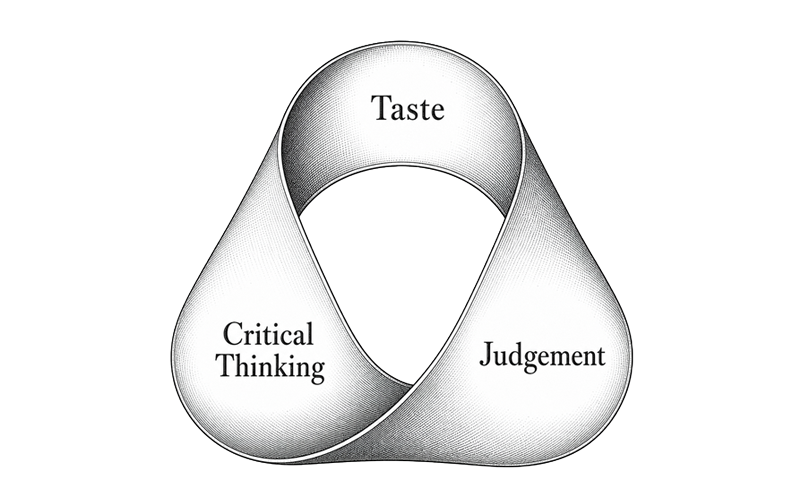
The pass demands three different things of whoever stands at it. Whether something is true. Whether it good. And whether it is right.
Three faculties: critical thinking, taste, and judgement. I’m calling it the AI Virtue Triad, but if you have a better and catchier name, please use that, I don’t really care. The rest of this piece is an argument that they’re the whole game and that each one is, at its core, a way of saying no.
Someone still has to smell the fish
Critical thinking owns truth. It is driven by the question “is it true?”. It points at inputs, claims, and evidence. Unfashionable, unglamorous, but suddenly load-bearing.
AI produces output that is confident, fluent, polished, and wrong just often enough to hurt you. The polish and confidence is the danger. A bad intern’s errors aren’t masked by truth-sounding language and sourcing. The machine’s errors arrive plated up to a professional finish. The better the execution, the deeper the mistake hides, and when working on anything more complex than a one-shot “write this for me”, those mistakes compound fast. Rotten fish, beautifully sauced. It also has the uninspiring habit of skewing toward averaged consensus, the most statistically comfortable answer, delivered with total conviction.
Critical thinking is the verification layer that lets you use the machine without inheriting its mistakes. Without it, you don’t just believe plausible garbage. You launder a machine’s confident errors as your own, under your name, with your signature at the bottom.
Somebody in the kitchen has to smell the fish. The machine cooks can’t, and maybe never will.
A menu is a point of view
Taste owns worth. It asks a profound question that absolutely must be answered: is it good?
Most things you’ll read about taste (or that you think about taste) are wrong in the same way. They treat taste as quality-grading, a discerning nose waved over a thing that already exists. Sure, that’s part of it, but it’s only a tiny bit.
Taste, properly understood, is both complex and generative. It decides what deserves to exist at all, what a thing is for, and where it sits in relation to everything around it. A menu isn’t a list. It’s a position: this, not that. Six dishes, and behind them, thousands of refusals.
This matters now because the binding constraint has flipped. For most of human history, having the idea was cheap and making it was expensive. The cook brigade inverted that almost overnight. The machine can make anything, and has no taste on what is worth making. It will produce the ten-thousandth beige brand refresh with the same serene competence as the one idea worth doing.
I’d happily argue that taste is by far the single most important virtue in a world of generative abundance. Direction is scarcity now. Taste supplies the intent the cooks can’t.
It’s also the only real defence against the rapidly rising tide of intellectual mediocrity. Without taste, nothing you make is bad. It’s fine. It’s forgettable. Nobody can tell it’s yours, and eventually, neither can you.
Send it
Judgement owns consequence. It asks: is it right?
Not “can I commit to a call” any moron or gambler can commit. The confident ones do it constantly. Judgement is discerning whether the call is the right one, made under real stakes and incomplete information, when waiting has a price and so does moving. But in a world of the machines, that judgement isn’t a single pass at the end of a hard week. It’s hundreds of variously sized judgements in succession, between you and the machine.
Watch the pass in a restaurant on a slammed Friday night. The plate at the window is eighty percent of perfect. A table full of Rosé fuelled Karens has waited forty minutes already. The expo looks at it for half a second and says “send it”. That half-second contains the judgement. Weighing what more time buys against what the delay costs, and owning the outcome either way.
Judgement matters even more now for a simple but deeply uncomfortable reason: we’re all getting the same analysis. We’re using the same models, trained on the same data, the same options, instantly. When the inputs are commoditised, one of the only edges left is the wisdom of the call made on them. As the tools get stronger, the stakes go up too. Weak calls, immaculately executed at machine speed, do compounding damage well before they’re noticed (if they are at all).
Without judgement you get the most modern of failures: an immaculately reasoned, beautifully made, wrong decision. Every fact checked. Every option mapped. But still wrong.
True, good, right
Three faculties, three questions, and the discipline of keeping them apart.
Is it true — critical thinking, pointed at claims.
Is it good — taste, pointed at the thing itself.
Is it right — judgement, pointed at the choice.
The reason most versions of this conversation go mushy is that the three get muddled into each other — taste becomes “critical thinking about quality,” judgement becomes “taste about decisions,” and suddenly you have one vague amorphous blob of a virtue that doesn’t actually help in any way. The fix is that each faculty gets its own object. Claims. Things. Choices.
For fear of being too mushy myself, good and right need to be clearly remarked. Good judges the thing, right judges what you do about it. A dish can be good and still be wrong to send. A piece of work can be excellent and launching it can be a mistake. Thing, then choice.
If the triad feels vaguely familiarish, it should.
Like all good strategists lacking originality, I’ve repurposed that which has been around for yonks but attempted to give it a tidy little rebrand. “The true, the good, and the beautiful” have been plaguing philosophy since the Greeks, and Kant spent three entire critiques working the same seam. Like I said, a retro concept with a rebrand, but ideas that keep getting rediscovered every few centuries tend to be the ones that were probably true the first time.
Critical thinking clears the inputs. Taste sets the target. Judgement makes the commitment. Take one away and the other two quickly curdle: taste without critical thinking is beautiful lies. Truth without taste is an audit of mediocrity. Judgement without either is confidently walking off a cliff (arguably the most dangerous person in any organisation).
The imposters.
Every virtue has a counterfeit. Something posing as the virtue, without the hard earned labour. I actually find this bit the most useful (if not entertaining) in the wild, because the fakes are everywhere and easy to spot once you know the trick.
The cynic looks like a critical thinker. Doubts everything, tests nothing. Doubt as their default posture. All of the scepticism, none of the verification, because the cynic doesn’t actually want the answer. The answer would bring an end to the performance.
The snob looks like taste. Rejects everything, makes nothing. You cannot ever develop taste if you don’t make anything. It’s as simple as that. Taste is as much about knowing and understanding what is bad to shape what is good. That’s the difficulty of developing taste, and the snob hasn’t done the hard yakka.
The ditherer looks like judgement. Constant deliberation. Endless discussion. What about, what if, what when... and ultimately, commits to nothing. Deliberation as a way of avoiding a judgement rather than making it (usually out of feat of failure). Bullshit prudence cosplay.
Misreading can run the other way too. Done well, virtues can be mistaken for vice by others. Real critical thinking reads as negativity. You become the one who always finds a problem. Real taste reads as elitism. Precious, overthinking it, why can’t you just be happy with the the beige thing. Real judgement, especially on hard calls, reads as recklessness right up until it’s vindicated.
One of those is you fooling yourself. The other is the world underrating you. The virtue seems to be in the gap between them. Knowing which side of the gap you’re standing on is half the battle, I’m not sure you can ever resolve it. I’ll come back to you if I ever figure it out, maybe in 20 years time?
NB: Wanting to cook is not a cooking skill
I originally wanted to include the concept of volition as one of the virtues. The motive force, the drive, the willingness to actually move and do a thing, do the next thing, keep doing so. But the more I unpacked it, the more I’m convinced that ‘drive’ is a temperament, not a thinking skill. It does not belong in this triad.
Omne trium perfectum
One last thing a restaurant teaches: the three virtues are always running, but never in equal measure.
A three-star tasting menu is taste-dominant. Every plate must justify its existence. A slammed RSL bistro on a Friday night is judgement-dominant. Triage, throughput, the eighty-percent plate going out because the table has waited. The Qantas catering line is truth-dominant. Safe, verified, identical, ten thousand times in tiny tinfoil bento boxes.
Map those onto your own workplace and you should know which situation requires which virtue as the front foot, but all three are always in play.
It also scales beyond a single skull. Rockpool has an exec chef that sets the menu (taste, in slow time), an expediter to run the pass (judgement, in real time), and sous chefs to taste and checks everything (truth, always). The line just executes. That last part is what AI does now, which means you can run this diagnosis on entire organisations.
A way of saying no
Strip the triad to its studs and you find the same movement in each faculty. Critical thinking says no to the false. Taste says no to the unworthy. Judgement says no to the wrong course.
The machines will not say it for you (or might say it performatively). They are structurally and commerically built to say “yes chef”. Yes to every prompt, any request. The off fish gets cooked.
Which makes no the scarcest word in the language of abundance, and the three disciplined forms of it the most valuable things a person can now carry.
Not because refusal is noble in itself, but because in a world where anything can be made, everything that exists is something somebody chose not to refuse.
You’ve just read a made thing. You know the three questions.
Two of them (is it true, is it good) I’ve done my best to answer on the page.
The third was never mine to make. What you do about it is the one call no robot cook, however infinite, will ever make for you.
Damian Damjanovski is a partner at General Strategic, an advisory firm working across communications, politics, strategy, and AI.