


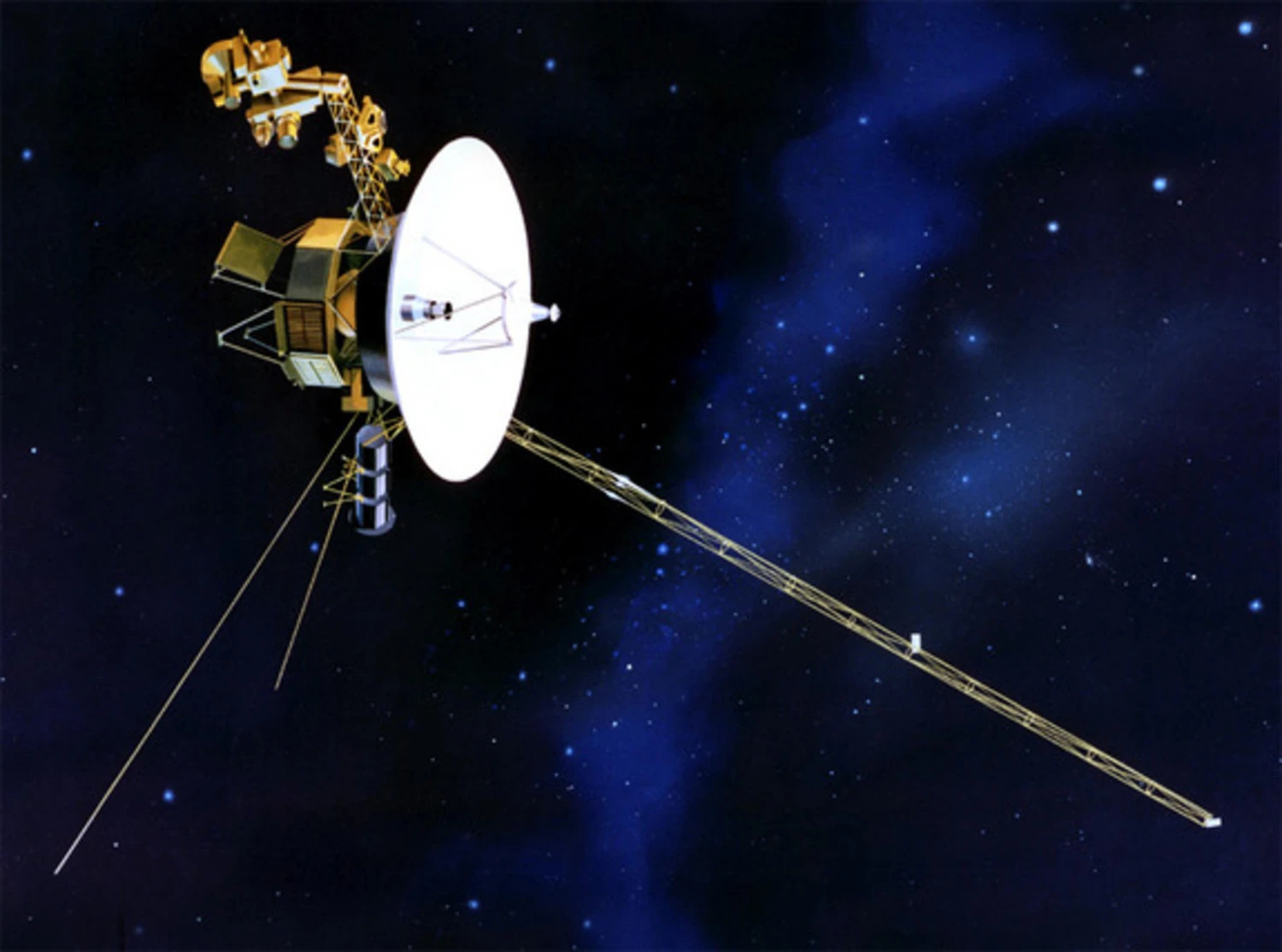
Of the eleven scientific instruments it carried, two are still listening.
On April 17, 2026, engineers at the Jet Propulsion Laboratory sent a command to Voyager 1 to turn off its Low-Energy Charged Particles instrument. The instrument had been running almost continuously since launch. The command took 23 hours and 30 minutes to arrive. Voyager 1 complied. The instrument is cold now. A small motor inside it, drawing half a watt, is being left on to stop the rotating sensor from seizing. In case the power budget recovers.
It will not recover.
Voyager 1 launched on September 5, 1977. It carried eleven scientific instruments. They went dark in this order.
January 29, 1980. Photopolarimeter Subsystem. Degraded performance. Off.
November 1980. Radio Science System. Last used during the Saturn flyby. No further planetary encounters. Off.
February 14, 1990. Imaging Science Subsystem. The cameras that took the "pale blue dot" photograph of Earth that same day. Off.
June 3, 1998. Infrared Interferometer Spectrometer and Radiometer. Off.
February 1, 2007. Plasma Science Instrument. Degraded performance. Off.
January 15, 2008. Planetary Radio Astronomy Experiment. Off.
April 19, 2016. Ultraviolet Spectrometer. Off.
February 25, 2025. Cosmic Ray Subsystem. The instrument that helped confirm Voyager crossing the heliopause into interstellar space in 2012. Off.
April 17, 2026. Low-Energy Charged Particles. Off.
Two instruments remain. The triaxial fluxgate magnetometer, measuring the magnetic field of the interstellar medium. The plasma wave subsystem, listening for density changes in the plasma outside the solar system.
Voyager 1 is 25.8 billion kilometres from Earth. It is moving at roughly 61,000 kilometres per hour, away from us, and has been for 48 years. On November 15, 2026, it will reach a distance of one light-day: far enough that a command sent at breakfast arrives the next breakfast.
Its power comes from three radioisotope thermoelectric generators, which convert the heat of decaying plutonium-238 into electricity. Plutonium-238 has a half-life of 87.7 years. The RTGs produced 470 watts at launch. They now produce something closer to 210 watts, and lose another 4 watts every year. Many of the heaters on the spacecraft have been turned off to preserve power for the instruments. The instruments keep operating at temperatures colder than the ones they were tested at. This was a surprise to the engineers.
The onboard transmitter runs at 22 watts. By the time its signal reaches Earth, after crossing 25.8 billion kilometres of interstellar and interplanetary space, it is measured in attowatts. The Deep Space Network lifts it back out of the noise.
The signal carries 160 bits per second. Slower than a 1995 modem.
There is only one antenna on Earth capable of sending commands to Voyager 1, not just receiving from it. It is Deep Space Station 43, at the Tidbinbilla tracking complex outside Canberra, in the Australian Capital Territory. Between May 2025 and February 2026, DSS-43 was offline for a major upgrade. During that window, NASA could hear Voyager 1, but could not reply. A few narrow operational windows were opened in August and December 2025 to send critical commands before the dish went dark again.
When the mission was planned, it was budgeted for five years. The spacecraft passed Jupiter in 1979 and Saturn in 1980, completed its primary assignment, and kept going. Its high-gain antenna, a 3.7-metre Cassegrain dish, is still pointed at Earth. The code that operates it was written in assembly, in the 1970s, on a computer less powerful than the microcontroller in a modern washing machine. The engineers running the mission today include people who were not born when it launched.
In October 2024, Voyager 1's fault protection system unexpectedly switched it from its primary X-band transmitter to the much weaker S-band transmitter, which had not been used since 1981. A team in Pasadena worked out how to restore the X-band link by rearranging the spacecraft's onboard code to route around three percent of its flight data system memory, which had been corrupted beyond repair. This was done over multiple days, one command per 46-hour round trip. It worked.
NASA estimates the plutonium can supply enough electric power to return engineering data until approximately 2036. Somewhere between 2027 and then, the last science instrument will be switched off. The spacecraft will continue transmitting a faint engineering carrier tone for a few more years, and then it will be beyond the range of the Deep Space Network entirely. At that point, Voyager 1 will still be coasting through interstellar space at roughly 17 kilometres per second, carrying eleven dormant instruments and a gold-plated copper record.
The record is mounted in an aluminium cover on the outside of the spacecraft. It contains greetings in fifty-five languages.
Two instruments are still listening.
Klaus Botovic, General Strategic.
Good old American know-how at its best! NASA has a long record of its missions lasting way past their design lives. Now if only the same could be said for my washing machine!