



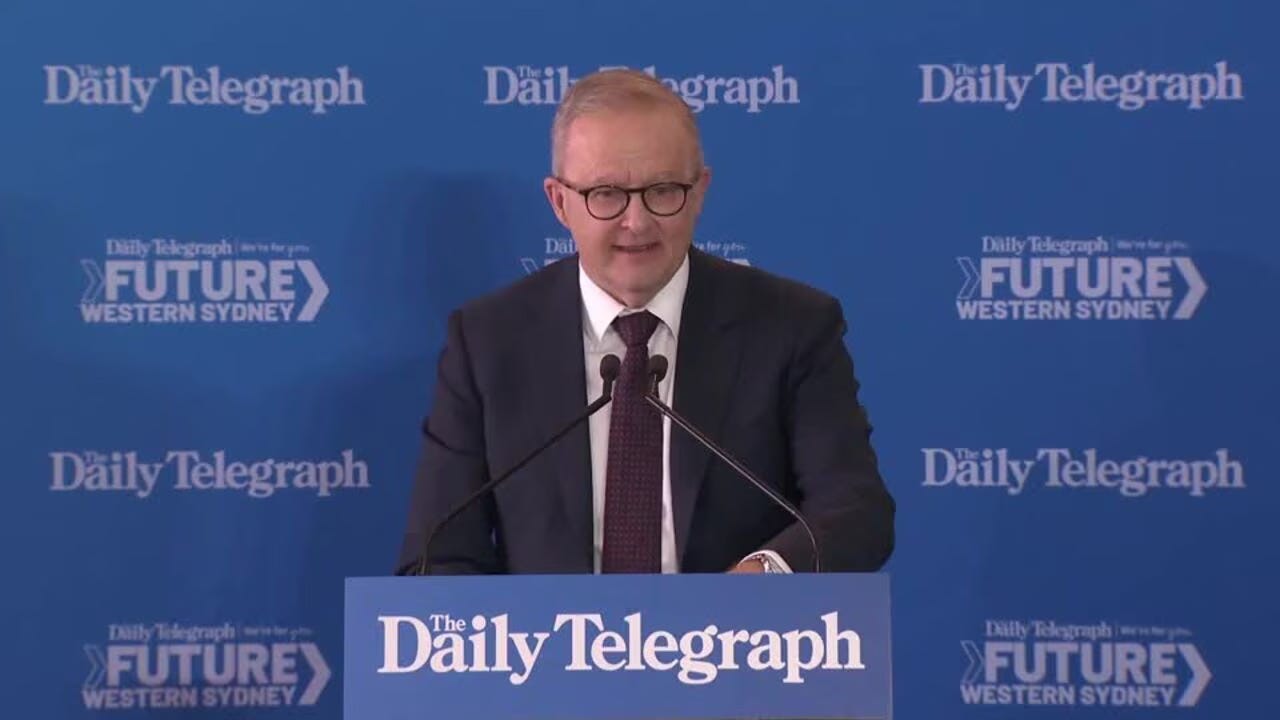
"There's a range of tax measures you can do to really go hard on equity. That's not at the front of them."
— Anthony Albanese, asked on Friday why he won't fix this.
Look at your last payslip.
Every year, your boss probably gives you a pay rise. Maybe it’s the size of inflation, maybe a bit more, maybe a bit less. Either way, the number on your payslip goes up. You celebrate, briefly. You buy a slightly nicer bottle of wine. You move on.
The government’s side of that same payslip works differently.
The tax system has steps in it. Earn up to a certain amount, you pay one rate of tax. Earn above that, the dollars over the line are taxed at a higher rate. Earn above the next line, higher again. Pretty standard. You’d expect those lines to move when the cost of living moves. They don’t.
The line where the highest tax rate kicks in (currently $190,000) has not moved since 2008. Eighteen years. Over those eighteen years, average wages have nearly doubled. A senior nurse, a mid-career engineer, a school principal — people who in 2008 were comfortably middle-class earners — are now creeping toward a tax bracket that was originally designed for executives and surgeons.
Same job. Same relative position in the economy.
More tax, every fortnight, forever.
This is bracket creep, and it is the largest, quietest tax rise in Australian history. Nobody voted for it. No politician campaigns on it. It doesn’t appear in any budget speech as a line item. It just runs in the background of every pay packet in the country, year after year.
A professor at the University of NSW has done the maths. On a fairly modest inflation rate, a worker on average full-time earnings will see their effective tax rate climb by about three percentage points over a decade — without ever getting a “real” pay rise. That is money the government collects without ever having to ask for it, ever having to defend it, ever having to put it on a poster.
Every other country with a tax system like ours (Canada, the Netherlands, Sweden, Switzerland, several others) automatically moves their tax brackets up each year to match inflation. It’s called indexing. It’s not radical. It’s just bookkeeping that respects the fact that a dollar in 2008 isn’t worth the same as a dollar in 2026.
Australia tried it once. In 1976, the Liberal government of Malcolm Fraser brought in full indexation. It lasted six years. The next conservative government, under Bob Hawke and then John Howard, killed it off. The reason both sides killed it is the reason it hasn’t come back since: bracket creep is too useful to politicians to give up.
The reason for this bastardry, is remarkably simple, and purely political.
When taxes drift up automatically, governments can let it happen for three to six years, then “give it back” as a tax cut just before an election.
The tax cut feels like a gift. Applaud the government and their benevolence.
The slow drift that paid for it is invisible. They get to look generous with money they were already taking from you. It’s the most reliable trick in the political playbook, and neither side wants to retire it.
So when the Prime Minister was asked on Friday whether his government would index the brackets (make them move with inflation, like every other developed country we compare ourselves to) he said no.
His first reason was that no government has done it before. That’s not true. Fraser did it in 1976.
The Coalition’s spokesperson on tax, Jane Hume, complains about bracket creep almost every week. She also won’t promise to fix it. The Coalition’s previous leader, Peter Dutton, flirted with the idea before the last election and walked it back.
Both parties keep their hands off this for the same reason. It’s free money to pay for promises, which can then be used as a political tactic by giving a “cut” in a few years time.
The Treasurer, to his credit, is going to do some genuinely useful things in the budget on the 12th of May. He’s likely to scale back a tax break on investment properties that lets older landlords reduce their wage tax by claiming losses on rental properties they own.
He’s likely to trim a discount on the profits people make when they sell investments — a discount that overwhelmingly benefits people who already own things, at the expense of people trying to buy their first home. There’s a third change coming for very large superannuation balances. All three are aimed at the same target: the way our tax system favours people who own assets over people who earn wages.
This is real reform. It’s harder than it looks. It will cost the government votes in places they need them. They deserve credit for doing it.
The fix would be the simplest thing in the budget. Move the lines. Match inflation. Stop pretending that an unchanged number means an unchanged cost.
But they’re not doing the simpler thing.
The biggest single way the tax system takes more from working people every year is not being fixed. The brackets don’t move while the wages do.
The reform package will be sold to you as making the system fairer for younger Australians, for wage-earners, for people without investment properties. Some of it really might.
But every fortnight after the legislation passes, the same wage-earner the government claims to be helping will keep paying a slightly higher tax rate than they did the fortnight before.
The small tax cut taking effect on the 1st of July (about $268 a year for someone earning over $45,000) will be eaten up by bracket creep inside three years. After that, the worker is paying more again.
Quietly. Automatically. Without anyone having to admit it.
The fix would be the simplest thing in the budget. Move the lines. Match inflation. Stop pretending that an unchanged number means an unchanged cost.
The reason no government will do it is the same reason every government needs you not to notice it.
Damian Damjanovski is a director at General Strategic. He outsourced the original of this piece to the AI and then had to rewrite it for the rest of us.
Klaus Botovic is a non-payroll observer of payroll outcomes at General Strategic. He keeps a spreadsheet of every promise made about your pay slip, and a second spreadsheet of what your pay slip actually said the next month.