


The cynicism isn’t irrational. It’s a perfectly calibrated response to the product being offered.
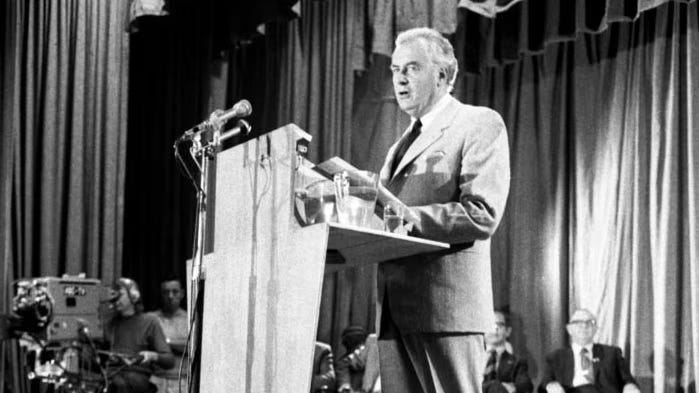
There’s a video of Gough Whitlam answering a hostile question at a public meeting in 1972. No lectern notes. No media advisor whispering in his ear. Just a man with a command of language, policy, and argument, constructing a response in real time that was simultaneously withering, funny, and substantively correct.
You could disagree with every word of it. But you couldn’t call it stupid.
Now watch a politician (from either side) handle a press conference in 2026.
You’ll hear the same dozen or so words, arranged in the same order, repeated with the mechanical cadence of someone who’s been told that if they say it enough times, it becomes true.
Stop the boats. Axe the tax. Jobs and growth. Real change. Cost of living.
These aren’t arguments. They’re not even sentences, really. They’re sonic logos — jingles for governance. And the people delivering them have law degrees.
That’s the part worth sitting with. The education levels in parliament have never been higher. More degrees, more postgraduates, more Rhodes Scholars, more barristers per square metre than at any point in Australian political history. And the quality of public political language has never been lower.
But it’s not just parliament. The people listening are more educated than ever, too. A third of Australian adults now hold a bachelor’s degree or above — up from one in five at the turn of the century. Among 25 to 34 year olds, it’s nearly half. We have the most educated electorate in the country’s history being spoken to like they’re standing in a school assembly.
The lazy explanation is “technology and media”. Television compressed political communication into grabs. Social media compressed it further into slogans. The attention economy rewarded brevity and punished nuance. All true. All incomplete.
The real answer is quieter, more structural, and — if you work in or around politics — slightly uncomfortable.
The business ate the craft.
Somewhere between Menzies and Albanese, political communication stopped being something politicians did and became something that was done to them. A professional class emerged — strategists, pollsters, media advisors, message testers, opposition researchers — whose entire job is to stand between a politician and an unscripted thought.
That class includes people like me, by the way. I’m not pointing from a distance.
The machinery works like this. A focus group in Penrith hears six different framings of a policy position. The one that tests best — the one that produces the least resistance and the most nods from people who were promised a $150 gift voucher and a sandwich — becomes “the line.” The line gets approved by the leader’s office, distributed to every frontbencher, embedded into talking points, and repeated until it loses all meaning. Which, to the professionals, is actually the point. Meaning is a liability. Meaning can be misinterpreted, fact-checked, turned against you. A slogan with no content can’t be wrong, because it doesn’t actually say anything.
“Strong economy. Strong future.” What does that mean? Nothing. That’s the feature.
The people who build these systems aren’t stupid. They’re very, very good at what they do. And what they do is optimise for the marginal voter in the marginal seat who has the least engagement with politics and the highest sensitivity to perceived risk. You don’t write for the engaged. You write for the people who’ll spend eleven seconds on your message between the school run and the grocery shop.
When your target audience is the least attentive person in the electorate, the rational move is to simplify until there’s nothing left to misunderstand.
So that’s what happened. Not a decline in intelligence. A triumph of optimisation.
What optimisation broke.
Menzies wrote his own speeches. Whitlam wrote his own speeches. Keating wrote his own — or at the very least, his speechwriters were given enough latitude that the result still sounded like a mind at work. Even Howard, whatever you thought of his politics, could construct an argument in public that had a beginning, a middle, and a logical conclusion.
These weren’t just better speakers. They were the strategists. The thinking and the speaking were done by the same person. The argument was live, because the person making it understood it well enough to adapt, to respond, to go off-script without falling apart.
The professionalisation of politics separated the author from the performer.
The strategist writes the line. The candidate delivers it. The minister repeats it. And if anyone asks a follow-up question that wasn’t in the brief, the whole thing collapses into either aggression or deflection — because the person at the microphone doesn’t actually own the argument. They’re performing someone else’s certainty.
That’s why Q&A sessions feel so hollow now. That’s why press conferences feel like hostage videos. The person talking can’t think out loud, because thinking out loud might produce a thought that hasn’t been tested in Penrith.
And the audience adapted.
We stopped expecting substance because substance stopped being offered. A generation of voters — many of them degree-educated, well-read, and perfectly capable of following a complex argument — has grown up hearing nothing but slogans from their elected representatives. And they’ve drawn the reasonable conclusion that this is what politics is. Not the negotiation of competing ideas about how to organise a society, but a branding exercise where two teams compete for the privilege of managing the same spreadsheet.
The cynicism isn’t irrational. It’s a perfectly calibrated response to the product being offered.
Meanwhile, the very professionals who stripped the language down will tell you, with no apparent irony, that “trust in politics is at an all-time low.” As though trust is something you can rebuild with the same tools you used to destroy it. As though one more focus-tested slogan about “restoring integrity” will do the trick.
It won’t. Because people can hear the difference between someone who believes what they’re saying and someone who’s been told to say it. The human ear is better at detecting authenticity than any focus group is at manufacturing it.
The fix isn’t nostalgia.
I’m not arguing we need to go back to two-hour parliamentary orations. The world changed, media changed, attention changed. That’s fine.
But the professionalisation of political communication has produced a paradox: we have the most educated political class in history, speaking to the most educated electorate in history, and doing it at the lowest level in history — because the system they built rewards simplicity over substance and punishes anyone who treats the voter like an adult.
The politicians who break through — whatever their politics — are almost always the ones willing to say something that hasn’t been tested. To think out loud. To risk being wrong in public. To treat the voter as a participant in an argument rather than a target for a jingle.
That’s not a left-right observation. It’s a craft observation.
Political rhetoric didn’t get dumber because we got dumber. It got dumber because smart people built a machine that produces dumb outputs, and then mistook the output for the audience.