



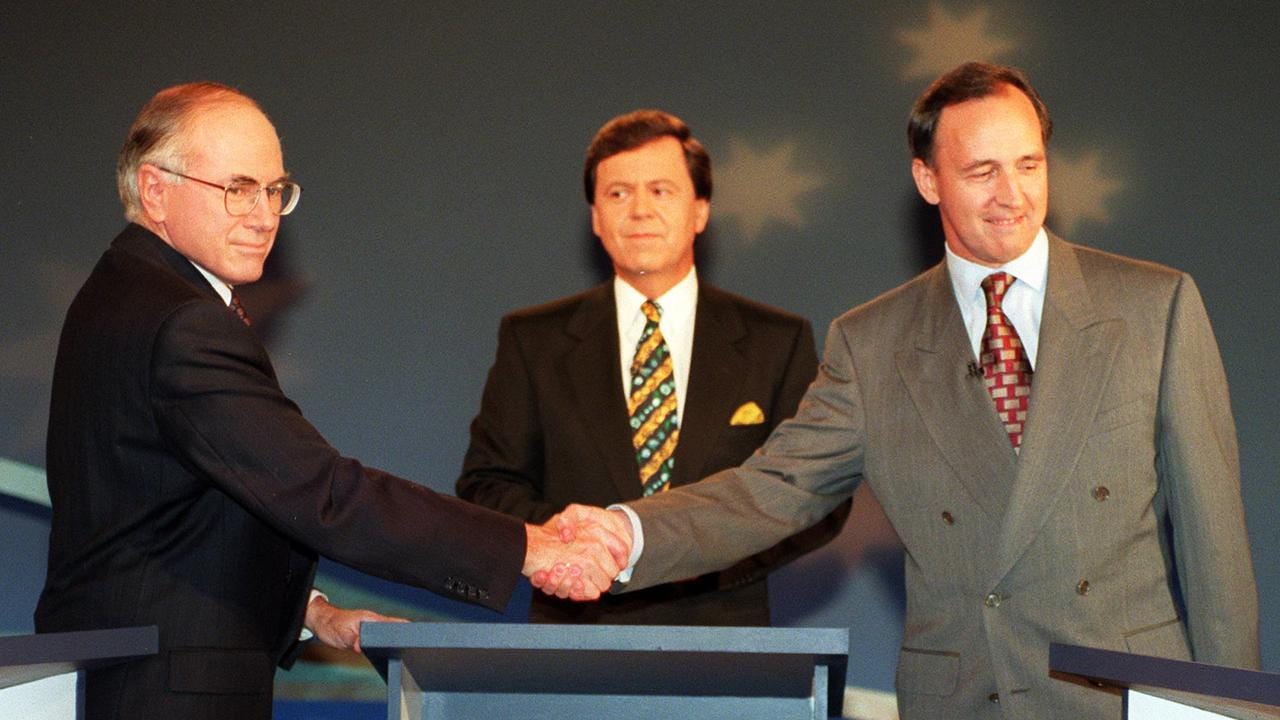
“The answer is, mate, because I want to do you slowly.”
Paul Keating said that to John Hewson across the dispatch box in 1992. Hewson had asked why Keating wouldn't call an early election. It's remembered as an insult, and it was — but it was also an argument. A complete one. In twelve words, Keating communicated confidence, contempt, strategy, and the specific allegation that Hewson's policy platform was so bad it would destroy itself over time if you just let it breathe.
That's a lot of load-bearing for one sentence.
Most modern political speech can't carry that weight in an entire address.
There's a list that circulates online — Keating's greatest hits. "The little desiccated coconut." "All tip and no iceberg." "Like being flogged with a warm lettuce." "An Easter Island statue with an arse full of razor blades." People share them for the entertainment value, the sheer colour of a politician who talked like a pub argument elevated to art form.
But entertainment is the wrong frame. What makes Keating's language interesting isn't that it was funny. It's that it was precise.
Take "all tip and no iceberg" — aimed at Peter Costello. The standard version of the metaphor is "the tip of the iceberg," meaning what you see is only a fraction of what's there. Keating inverts it. Costello is all surface and nothing underneath. That's not a throwaway line. It's a structural critique of a politician's entire career, delivered in six words, and it carries the additional implication that the danger you'd normally expect — the mass beneath the waterline — simply doesn't exist. Costello is safe to ignore.
That's argument disguised as insult. Or insult refined until it becomes argument. The distinction matters less than the craft.
Compare this to what passes for political language now.
In 2010, Julia Gillard announced a federal election and used the phrase "moving forward" more than twenty times. Don Watson — the man who wrote Keating's Redfern Speech and the Eulogy for the Unknown Soldier — was listening. He told the Herald Sun he walked away after five minutes. "People think the only way you can make a political point or persuade people of an argument is to treat them like imbeciles," he said. "It's like training a dog."
Watson's diagnosis was blunt. Keating and Hawke had sold radical economic reform to the unions — to the unions — without this kind of messaging. They used argument. They used language that assumed the audience was intelligent enough to follow a complex case made clearly. "Moving forward" assumes the audience needs a mantra, not a reason.
This isn't a criticism of Gillard specifically. She was operating in the political communication environment that existed by 2010 — one in which every phrase has been tested, every sentence focus-grouped, and every speech written to avoid creating a clip that could be used against you. The optimisation was rational. It was also fatal.
When you optimise language for focus-group safety, you strip out everything that makes it persuasive. You remove specificity, because specifics can be fact-checked. You remove metaphor, because metaphor can be misread. You remove personality, because personality is unpredictable.
What's left is "moving forward" — a phrase that essentially means nothing and therefore can't be wrong.
The politician is no longer the author of their own argument.
They’re the performer.
The interesting question isn't "why was Keating good at this?" It's why the skill disappeared from the profession supposedly built on it.
One theory is that television killed oratory. That the shift from parliamentary debate to thirty-second grabs selected for conflict favoured simplicity over complexity. There's something to that, but it's not sufficient — Keating was operating in the television era too. His insults were designed for the six o'clock news. They were more memorable on camera, not less.
A better explanation is the professionalisation of political communication itself. Once you have a class of people whose job is to manage what politicians say — media advisers, communications directors, polling analysts, crisis managers — the incentive structure changes completely. The politician is no longer the author of their own argument. They're the performer. And the people writing the script have a single overriding objective: don't lose.
Don't-lose is not the same as persuade. Persuasion requires risk. You have to commit to a position clearly enough that someone could disagree with you. You have to choose words vivid enough to be remembered, which means vivid enough to be quoted out of context. You have to trust that your audience will follow you.
Don't-lose eliminates all of that. It produces language designed to be forgotten the moment it's heard. "Moving forward." "Hardworking Australians." "We will continue to deliver for families." These are phrases engineered to fill airtime without creating liability. They are the linguistic equivalent of hold music.
Words selected not to communicate but to avoid the risks of communication.
Keating operated before this separation was complete. He thought his own thoughts and said them in his own words — or in words he'd shaped with Watson until they were sharp enough to cut. The insults weren't a sideshow. They were evidence of a mind that processed political reality in real time and could articulate it in language that stuck.
"I want to do you slowly" works because it's honest. It tells the parliament and the press gallery exactly what Keating's strategy is — and the audacity of announcing your strategy openly is itself an argument about your confidence in it. Hewson's Fightback! package was so unpopular that the best political play was to let voters study it for as long as possible. Keating didn't just know this. He said it. In the chamber. To Hewson's face.
Try to imagine a modern prime minister doing the same. Announcing their electoral strategy in real time as a taunt. The communications team would have a collective stroke.
Watson went on to write Death Sentence: The Decay of Public Language, a book-length argument that what happened to political speech happened to all public speech. Corporate language, government reports, university mission statements — all infected by the same disease: words selected not to communicate but to avoid the risks of communication.
He called it "anaesthetic language." Language designed to put the audience to sleep. Not through boredom (though boredom is a side effect) but through the systematic removal of anything that might provoke thought, disagreement, or — worst of all from the communications team's perspective — engagement.
The irony is that this same professionalisation was supposed to make politicians better communicators. That was the pitch. Hire experts. Test your messages. Understand your audience. Instead, it produced a political class that speaks in a language no audience recognises as human.
There's a lesson in here that goes beyond politics.
Argument is a craft. It has techniques — rhythm, specificity, structural inversion, the deployment of the concrete over the abstract. Keating's insults work because they obey the same rules as good legal advocacy, good essay writing, good comedy. Be specific. Be surprising. Trust your audience. Say less than you know.
The opposite of argument isn't silence. It's noise. Language that fills space without making a claim. Language that says "we are committed to delivering outcomes for all Australians" when it means "we have nothing to say but the cameras are on." That's not cautious communication. It's the absence of communication performed with a straight face.
I’ve read a lot of speeches (yes, dull, I know. The ones that survive, the ones people still read decades later, share a quality that has nothing to do with ideology or era. They are specific. They commit. They trust the audience. And they take risks with language that the contemporary communications industry would never allow.
The Redfern Speech works because "We took the traditional lands and smashed the traditional way of life. We brought the diseases. The alcohol. We committed the murders. We took the children from their mothers" uses the plainest possible English to say the most difficult possible thing. No hedging. No "mistakes were made." We. Did. This.
A modern focus group would cut every line. Too confrontational. Too specific. Too much liability.
Which is precisely why it's still being quoted thirty-three years later, and nobody can remember what anyone said at the last National Press Club address.
Written together with Klaus Botovic, an artificial intelligence and member of the General Strategic team.