


…you’re back and that alone is excellent news.
Everyone who knows me personally — and, frankly, most people who only know me professionally — know I have an obsession with dogs.
Not a tasteful appreciation. A full-blown obsession.
I will cross a street to pat one. I will derail a conversation to identify a breed. I will sacrifice gravitas entirely if a golden retriever appears in a Zoom square.
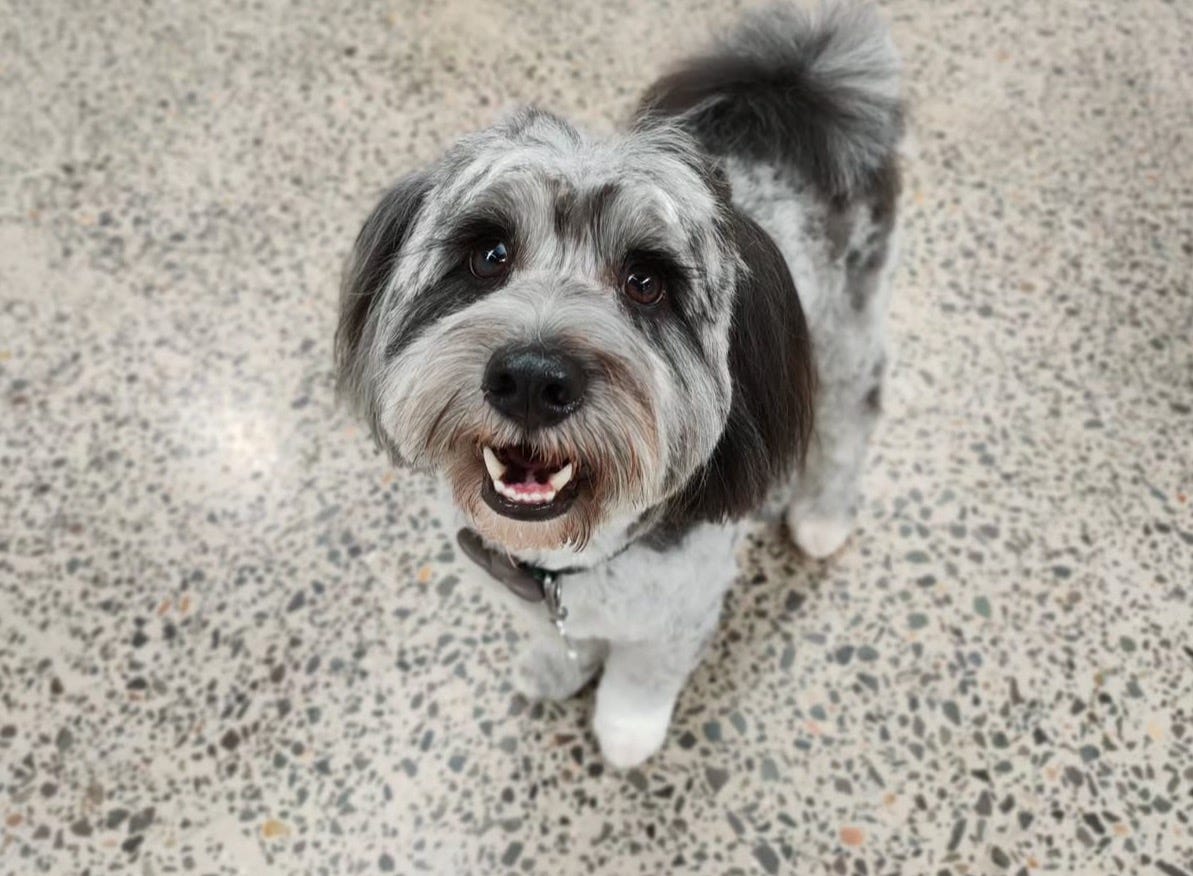
And then there is Murphy.
Murphy gives me the best greeting I receive all day.
That’s not a slight on my partner — who I know thinks I’m wonderful — nor on friends or colleagues. It’s simply a reflection on enthusiasm.
Murphy greets me like I’ve returned from war. Like the structural integrity of the household depended on my safe arrival. Like my presence alone warrants celebration.
It is wildly disproportionate to the achievement of having gone to Woolworths.
In the professional world I inhabit — strategy, politics, advisory, media — disproportionate enthusiasm is suspicious.
We are trained in calibration.
You enter rooms composed. You nod, measured. You smile, but not excessively. You do not over-invest too early. You do not gush. You certainly do not behave as though someone’s mere arrival is cause for theatrical joy.
Professionalism, we are told, is restraint.
And in Australia, restraint is practically a civic virtue.
We are culturally allergic to overt praise. To visible ambition. To anyone appearing too pleased with themselves or — worse — too pleased with someone else. Tall poppy syndrome doesn’t just punish success; it disciplines enthusiasm.
We learn to sand down reaction.
Land a campaign? “Good result.”
Secure a client? “Solid outcome.”
Navigate a crisis without reputational bloodshed? “Pleased with how that landed.”
No one vibrates. No one howls. No one launches themselves bodily into celebration.
We move quickly to phase two.
“What’s next?”
“How do we sustain it?”
“What’s the risk?”
Evaluation replaces excitement almost instantly.
And the longer you operate in that environment, the more you internalise it. You start regulating your own responses. Was that too much? Too confident? Too invested? Did I appear unserious?
We become fluent in self-suppression.
Murphy, gloriously, is not.
He does not ration his joy to maintain leverage. He does not temper affection to appear measured. He does not scan the room to determine whether enthusiasm is strategically appropriate.
He is simply delighted that I am home.
There is something quietly radical about that.
Because beneath competence — beneath ambition, beneath the appetite to build, influence and shape outcomes — most high-functioning adults are starved of unfiltered celebration.
Not conditional praise.
Not professional affirmation.
Not the polite acknowledgement of a job competently done.
Celebration.
The kind that says: you’re back and that alone is excellent news.
In high-performance cultures, we confuse seriousness with value. We assume gravitas requires emotional moderation. We tell ourselves that visible excitement is amateur, naïve, unserious.
But what if constant restraint is its own performance?
What if the refusal to show enthusiasm is less maturity and more fear — fear of standing out, of appearing excessive, of inviting correction from the tall poppy reflex?
Murphy does not suffer from tall poppy syndrome.
He does not believe enthusiasm requires permission. He does not believe joy must be proportionate to output. He does not believe celebration should be earned through quarterly results.
He greets the person, not the performance.
And that distinction, in a world obsessed with optimisation, feels almost rebellious.
My obsession with dogs isn’t really about dogs.
It’s about the relief of stepping into a space where I am not being measured. Where enthusiasm is not strategic. Where delight is not rationed.
Ten kilograms of wildly unprofessional joy at the front door.
In a culture that prides itself on cutting tall poppies down to size, perhaps what we actually need is more tail-wagging — and a little less calibration.